
What Is CMMC?
The Cybersecurity Maturity Model Certification, known as CMMC, is a framework developed by the U.S. Department of Defense to ensure that defense contractors and their subcontractors adequately protect sensitive government information — specifically Controlled Unclassified Information, or CUI.
CMMC was introduced because the DoD recognized that weak cybersecurity practices across the defense industrial base were creating serious national security vulnerabilities. Adversaries were — and continue to be — targeting smaller contractors and subcontractors as entry points into the broader defense supply chain.
The current version, CMMC 2.0, streamlines the original five-level framework into three levels and aligns closely with existing NIST standards that many contractors may already be working toward.
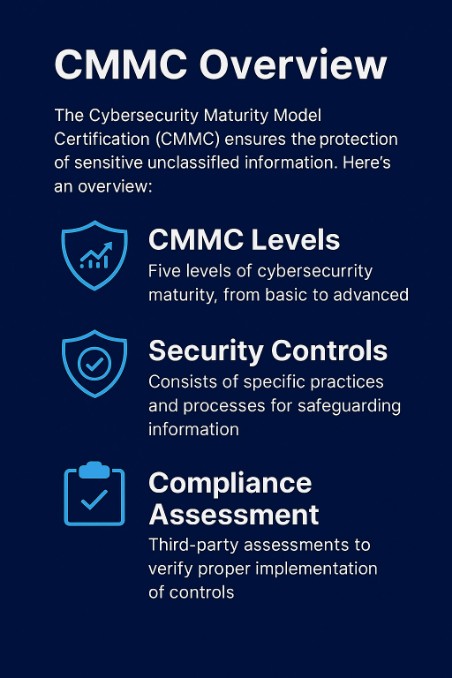
CMMC covers three core areas: certification levels, security controls, and third-party compliance assessments.
The Three Levels of CMMC 2.0
Understanding which level applies to your business is the essential first step. Most Orange County defense contractors fall into Level 1 or Level 2.
Basic Cyber Hygiene
17 practices based on FAR 52.204-21. Annual self-assessment. For contractors who handle Federal Contract Information (FCI) but not CUI.
Intermediate Cyber Hygiene
110 practices aligned with NIST SP 800-171. Third-party assessment (C3PAO) required for most contracts. For contractors who handle CUI.
Good Cyber Hygiene
110+ practices based on NIST SP 800-172. Government-led assessment. For contractors on the most critical DoD programs.
If your business handles any Controlled Unclassified Information — technical drawings, specifications, export-controlled data, or any information marked CUI — you almost certainly need CMMC Level 2 certification. This applies even if you are a subcontractor to a prime, not a direct DoD contractor.
Why Orange County Defense Contractors Need to Act Now
Orange County has a significant concentration of aerospace, defense technology, and government services companies — particularly in Huntington Beach, Seal Beach, Irvine, and the I-405 corridor. Companies like Boeing (Long Beach/Seal Beach), Raytheon, Northrop Grumman, and dozens of their subcontractors and suppliers operate throughout OC.
If your business is in the supply chain — even as a second or third-tier subcontractor — you are subject to CMMC requirements when handling CUI. The DoD has been phasing CMMC requirements into contracts since 2025, and enforcement is accelerating through 2026 and 2027.
The consequences of non-compliance are straightforward: you will not be awarded or permitted to continue on contracts that require CMMC certification. For businesses where DoD contracts represent a meaningful portion of revenue, this is an existential issue — not a nice-to-have.
CMMC requirements are being phased into new DoD contracts and contract renewals on a rolling basis through 2026–2028. If your contract comes up for renewal and you are not certified, you cannot continue on that contract. Starting the process 12–18 months before renewal is strongly recommended.
What CMMC Level 2 Actually Requires
CMMC Level 2 is built on the 110 security practices defined in NIST SP 800-171, organized across 14 domains. For most small and mid-sized businesses, this represents a significant body of technical and administrative work.
The 14 domains cover:
- Access Control — who can access what systems and data, and under what conditions
- Awareness and Training — ensuring all staff understand cybersecurity responsibilities
- Audit and Accountability — logging and monitoring system activity
- Configuration Management — maintaining secure baseline configurations for all systems
- Identification and Authentication — multi-factor authentication, password policies, account management
- Incident Response — documented plan for detecting, responding to, and recovering from incidents
- Maintenance — controlled, documented maintenance of organizational systems
- Media Protection — controlling how CUI is stored, transported, and destroyed
- Personnel Security — screening and managing personnel with system access
- Physical Protection — controlling physical access to systems and facilities
- Risk Assessment — regularly evaluating risks to organizational operations
- Security Assessment — ongoing monitoring and testing of security controls
- System and Communications Protection — securing networks and data in transit
- System and Information Integrity — malware protection, security alerts, software patching
The CMMC Certification Process: Step by Step
Here is the realistic path to CMMC Level 2 certification for most Orange County small businesses:
Gap Assessment
A qualified IT partner evaluates your current security posture against all 110 NIST SP 800-171 practices and identifies every gap. This produces a prioritized remediation list and gives you a realistic picture of how much work — and cost — is involved.
System Security Plan (SSP)
You must document how your organization implements — or plans to implement — every required security control. The SSP is a formal document that describes your system boundaries, the data flows involving CUI, and your security control implementations.
Plan of Action & Milestones (POA&M)
For any gaps identified, you need a documented plan with timelines for remediation. A POA&M shows the DoD that you are aware of your gaps and are actively addressing them.
Remediation
Implement the technical controls identified in your gap assessment — MFA, endpoint detection, encrypted storage, network segmentation, access logging, and more. This is typically the most time and cost-intensive phase.
C3PAO Assessment
For Level 2 contracts requiring third-party certification, a CMMC Third Party Assessment Organization (C3PAO) conducts a formal audit of your environment, documentation, and practices. This results in your official CMMC Level 2 certification.
Ongoing Compliance
CMMC is not a one-time certification. Maintaining compliance requires continuous monitoring, regular employee training, annual reviews, and updates to your SSP whenever your environment changes.
How IT Support Orange County Helps with CMMC
We work with Orange County defense contractors and subcontractors through every phase of the CMMC journey. Our role is to handle the technical implementation so you can focus on running your business — not learning cybersecurity frameworks.
Here's specifically what we provide:
- CMMC Gap Assessment — a full evaluation of your current environment against NIST SP 800-171 requirements, with a written report and prioritized remediation plan
- SSP Documentation — we draft your System Security Plan, describing your environment and control implementations in the format assessors expect
- Technical Remediation — implementation of the security controls your assessment identifies: MFA, EDR, network segmentation, encrypted storage, access logging, patch management, and more
- Employee Security Training — CMMC requires documented security awareness training for all staff who touch CUI or related systems
- C3PAO Preparation — we prepare your documentation package and conduct a pre-assessment walkthrough so there are no surprises during your formal audit
- Ongoing Compliance Management — post-certification monitoring, annual reviews, and SSP maintenance as your environment evolves
We offer a free initial CMMC gap assessment for Orange County defense contractors. We'll identify where you stand today and give you a clear picture of what's required to achieve certification. Schedule yours here or call (949) 348-3300.
How Much Does CMMC Compliance Cost?
This is the question every business owner asks, and the honest answer is: it depends heavily on where you're starting from.
For a small business with 10–25 employees that already has reasonable baseline security practices, the total cost to achieve CMMC Level 2 typically falls between $30,000 and $80,000 — including gap remediation, documentation, technology upgrades, and the C3PAO assessment itself.
For a business with significant security gaps, older infrastructure, or a complex network environment, costs can be higher. The C3PAO assessment alone typically runs $20,000–$50,000 for a small business.
Ongoing compliance maintenance after certification typically runs $1,500–$4,000 per month depending on the size and complexity of your environment — this is generally included in a managed IT plan at the Enterprise tier.
The cost of CMMC compliance is significant — but compare it to the value of the contracts at stake. If DoD work represents $500,000 or more in annual revenue, the investment in certification is straightforward. The risk of losing those contracts to a certified competitor is the real cost of inaction.
CMMC Readiness Checklist for OC Contractors
Use this checklist to get a quick sense of where your business stands today:
We have identified all systems, users, and data flows that involve CUI
Multi-factor authentication (MFA) is enabled for all user accounts and remote access
We have a documented System Security Plan (SSP) describing our security controls
All endpoints have advanced endpoint detection and response (EDR) protection
We have a documented incident response plan that has been tested
All staff who handle CUI have completed documented security awareness training
System activity and access is logged and monitored
CUI data at rest and in transit is encrypted
We have a documented backup and disaster recovery plan that is regularly tested
We know our CMMC contract deadline and have a timeline to achieve certification
If you couldn't check most of these boxes, you have meaningful work ahead before a C3PAO assessment. The good news is that with the right IT partner, the path is clear and manageable — and a free gap assessment will give you an honest picture of exactly where you stand.